
“I’m in the process of configuring a motorhome. What should I go for, gas or diesel heating?” As soon as someone asks this question in a motorhome forum, the discussions start and everyone knows better. I haven’t found a major controversial topic yet, only power supply with lithium can keep up.
By transforming our GC, we can represent both sides. In our first Grand California, we had the standard gas heater. The heater itself was nothing to complain about, certainly there were the known problems with the VW software, but we’ll leave that out of this, because Truma can’t do anything about it and it misses the point.
Before we answer the topic from our point of view, please keep in mind that it is our opinion and it represents our intended use. Every person has different expectations and requirements.
Which is better now? Gas or diesel heating or even a combination with a parking heater in the driver’s cab?
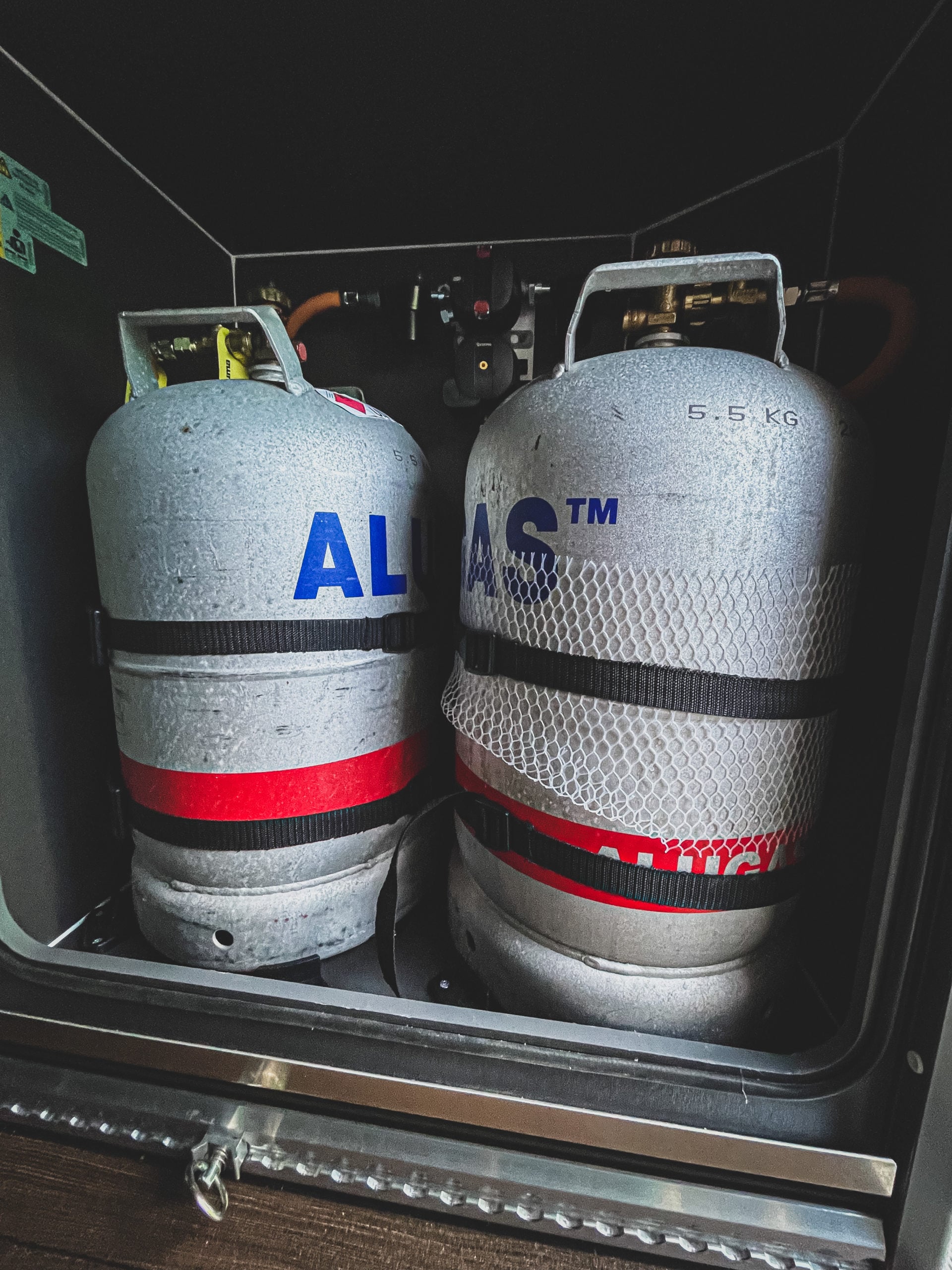
We opted for a diesel heater with electric heating rods in our new Grand California and would do it again in a heartbeat. The gas heater ended up doing exactly the same thing, of course, heating, but the biggest criticism is changing the gas bottles. What is simply annoying and inconvenient in Germany can really become a problem abroad. Since we are mainly traveling in Scandinavia, the gas supply, especially in Sweden, looks really bad.
This is where we take a bit of a swing and bring in a story from our last vacation. We were in Jokkmokk, Lapland Sweden in January. At temperatures of -30 degrees, no matter what type of heater, consumes a lot of fuel. At these temperatures we had extra on Friday morning, the BOTH, we emphasize BOTH, gas bottles filled and thus had 22 kilos of gas on board. We thought, that will probably be enough, because we had already picked out a dealer on the way south, who fills German bottles, there we would have arrived on Tuesday. Thus, the gas supply had to last four days. At these temperatures, of course, the heating is running at full blast, we had set an interior temperature of 18 degrees here. We are not even sure if much more would have been possible at all, since the heater was already running at full load as it was. On Saturday morning we checked the gas bottles and were astonished, one of the two bottles was empty 😳. Within one day we consumed 11 kilos of gas, that’s not possible, was the first thought. Here we have copied two graphics from the Truma homepage and there it becomes clear, it can very well be.


Since the heater was running at full load and we assume a consumption of 500g per hour, you can therefore get 22 hours with an 11 kilo bottle. Of course, we not only heated, but also cooked.
After the first shock, we had to save gas and write off the dealer on Tuesday. With a little luck, we made it through Sunday and by Monday morning both bottles were actually completely empty. We made our way to the nearest dealer who could fill the bottles, a detour of over 100 kilometers. We were still lucky in the misfortune, the bottle could have been empty even on Sunday at noon. What we would have done then? The last resort would have been to leave the car running.
Influenced by this experience and the dependence associated with it, we would not like to have gas heating again any time soon. Please keep in mind, we are always assuming the production vehicle here, there are of course ways to convert the Grand California so that you can fill the gas bottles yourself at a gas station. That would minimize the restrictions somewhat. Whereas diesel is available at every gas station. If we had already had diesel heating in Sweden, we would have just filled up on Saturday and not had to take a detour or worry about freezing.
Not all that glitters is gold!
Now at this point you can say, okay, save, we always take a diesel heater, after all, there are no disadvantages. Of course, that’s not true; no system is perfect. Here is a short overview of the pros and cons from our point of view in the Grand California.
Gas heating
Pros
- Standard, no surcharge ex works
- Combustion takes place almost without residues
- Low power consumption
- Less weight (related to the heater itself), especially with aluminum gas cylinders –>.
Cons
- Gas cylinder exchange in wind and weather
- No fill level overview ex works, yes here there are solutions, but not from VW
- Complicated gas cylinder system in Europe, which is associated with constant stress. In fact, each country has its own bottles and connections. Adapters are required or a bottle must be purchased locally.
Diesel heating
Pros
- Independence in fuel supply, diesel is drawn from the vehicle tank
- Level overview ex works (Grand California fuel gauge)
- Electric heaters as standard (heating via shore power)
Cons
- Significantly higher costs
- More weight (related to the heating system, weight is saved by eliminating the two large gas cylinders) – see https://grandcali.com/gasversorgung-bei-dieselheizung/
- Residues due to unburned diesel, with possible damage to the heating system.
These are a few examples of pros and cons of the two systems, depending on your own requirements, personal points may vary, of course. For us, it was simply the point of independence that tipped the scales. I can get diesel in every country I can drive to with the Grand California. For the gas supply either special adapters or bottles are needed and it is always necessary to look for a place where gas can be filled or refilled.
We did not notice any difference in the actual heating performance, nor can we confirm any noise or grime pollution, which is said to be a problem with diesel heating.
For those who travel a lot in winter, diesel heating is definitely the better choice. However, if you travel mainly in the summer and do not need the heating so often for this reason, you are better off with gas heating.
Finally, we would like to take up one more topic. There are some campers or fellow Cal drivers who swear by the auxiliary heater in the cab as a replacement or addition to the heater in the living area. Arguments are often brought here such as the gas supply lasts much longer when the parking heater is used in the front. Or so you have two independent systems. Of course, the gas heater consumes less gas when the diesel parking heater produces warm air in the front. It may even be enough to just run the parking heater in the front to keep the living area warm. However, you don’t have hot water in this case and it doesn’t really get warm in the back with it. In our case, however, we probably would have saved ourselves a detour to the gas dealer. We think this is a good argument in favor of the parking heater in the cab. The independence of the system ehr not, if really behind the heating fails, whether diesel or gas, would have run for us the vacation. We use the bathroom, and therefore the hot water supply, every day in our Grand California.
Yes well, long story short 😇
Those who travel mainly in the summer should take the gas heater. Possibly the electric heating rods to it, so you do not have to change the gas bottles so often. However, if you travel frequently in cold regions or even in winter, we would recommend diesel heating 100% for the reasons mentioned above. If money and weight are not an issue, the parking heater in the cab is a great add on, but not a must.
Please keep in mind, as mentioned above, this is our opinion and experience with both heater models in the Grand California. Since this topic is really hotly debated, consider it a field report.

