
Electricity is the main issue when we travel. This is not least because I am dependent on a CPAP machine at night. You can find an article on this topic here. Three years ago, we used to regulate the power supply with the help of a power station. This has now changed significantly, also thanks to the EFOY.
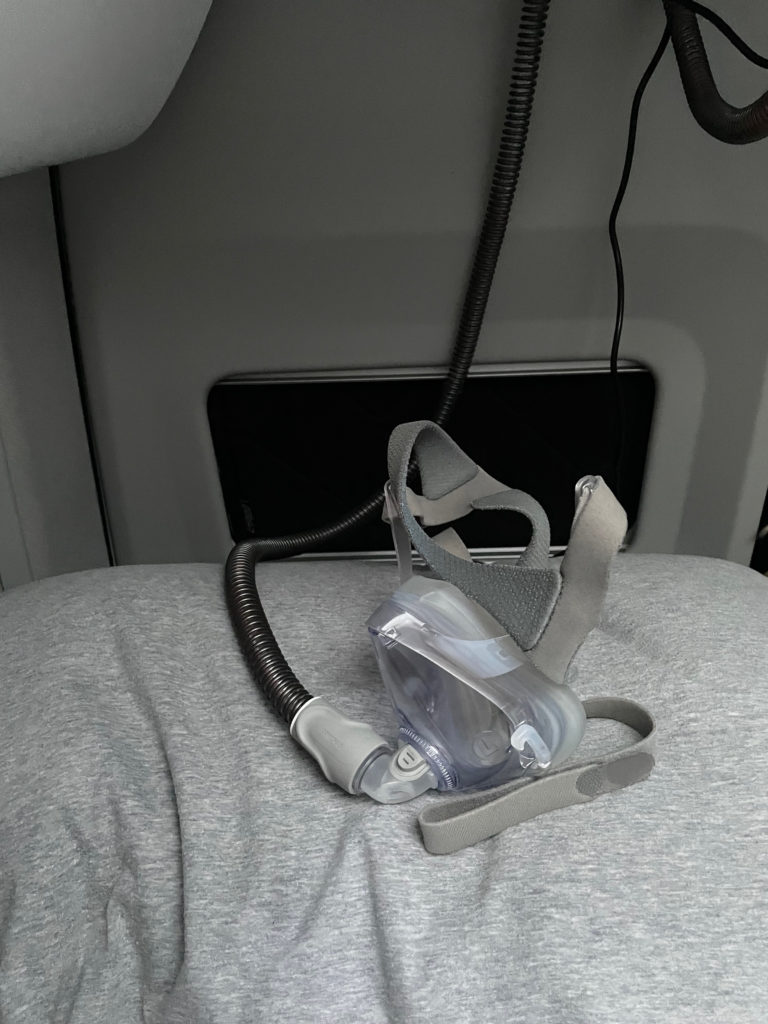
CPAP & Travel
I’ve thought about this topic a few times and whether I should write a post about it. It doesn’t fit into the bright and shiny
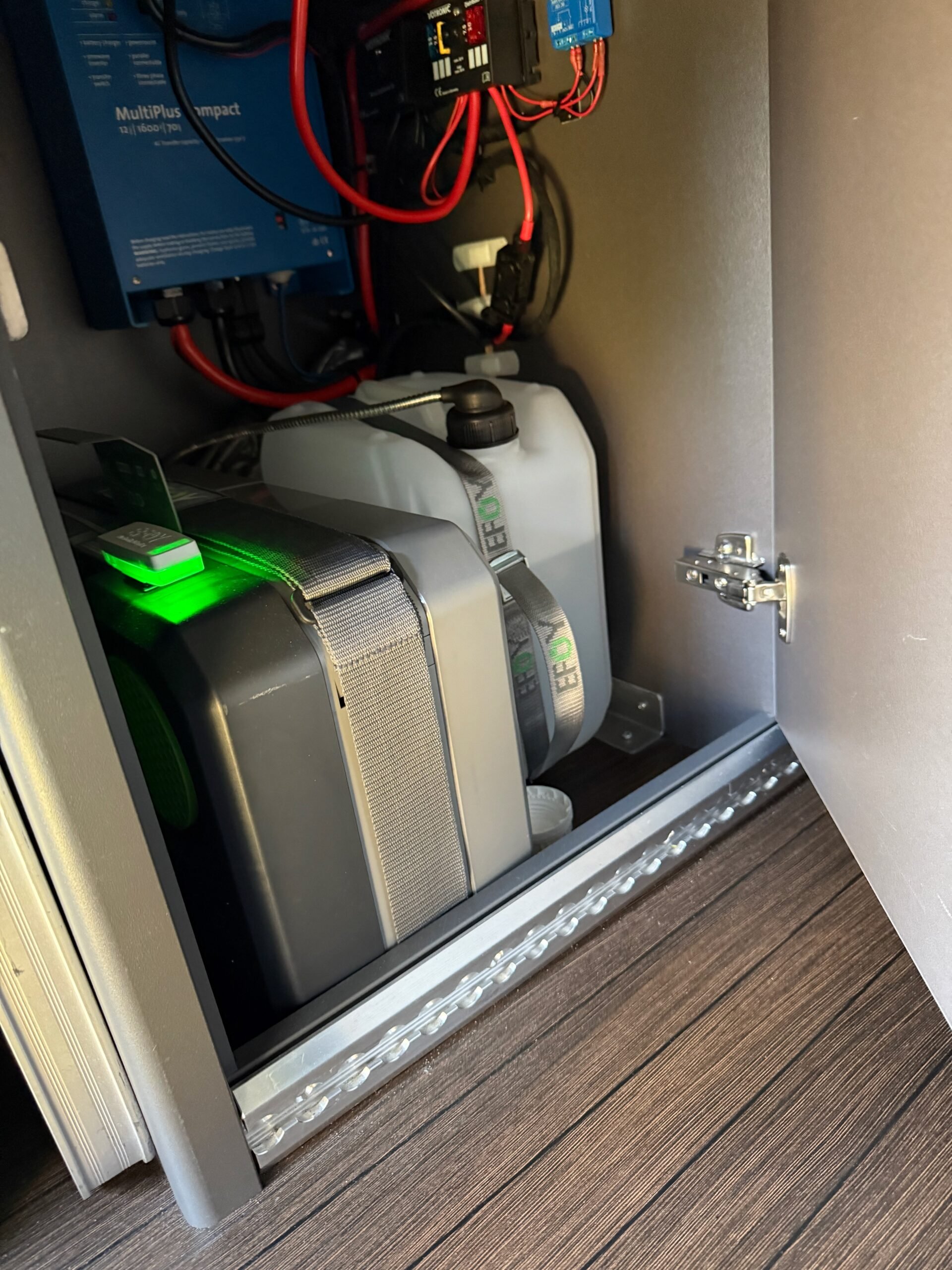
On the road to self-sufficiency, we installed two 150 Ah lithium batteries in our Grand California installed. Together with an inverter, I can now use my CPAP device without any concerns or restrictions.
My CPAP machine consumes about 56 watts per hour and we can draw about 1900 watt hours of power from one of our lithium batteries. Theoretically, I could sleep for 4 to 5 nights on one battery charge.
But that is only theory. In practice, my CPAP device requires 230 volts, so the inverter first has to convert the voltage from the battery to 230 volts. This results in losses and some of the energy is lost through the conversion. Although the losses are not huge, we can reckon with around ten percent – this energy is of course still missing in the end.
However, the batteries don’t just supply my CPAP device with power. Of course, we also want to use the fridge, charge our cell phones, run the heating and so on while on the road. In practice, this means that we can stand free for about three days with all consumers (except cooking – I’ll write about this separately later).
Avid readers will no doubt still have it in mind, but I’ll pick up on the cooking point again.
In one project, we converted our kitchen and made our Cali completely gas-free.
We now cook on an induction hob and that consumes electricity – a lot of it. One portion of our beloved spaghetti Bolognese takes half a battery charge. Even though we have installed a third 150 Ah battery in the process, the power – even if we cook – doesn’t last longer than two days.

Project GASFREI!
Because of our diesel heating, we only used gas for cooking. We’d been fed up with the huge gas bottle in the rear cupboard for
Now the EFOY comes into play

So if we are standing somewhere by a beautiful lake or in the forest in Sweden, the power supply quickly becomes difficult. We can’t generate the energy we need with our solar panels alone, and certainly not if the weather doesn’t cooperate.
Our EFOY 2800 now fills this gap. The fuel cell from SFC supplies us with a constant 110 watts, regardless of the weather. That’s 220 Ah in 24 hours. If you’ve been paying close attention, you’ll notice that we can cover our electricity needs pretty much exactly. All the EFOY needs is methanol.
Functional principle EFOY
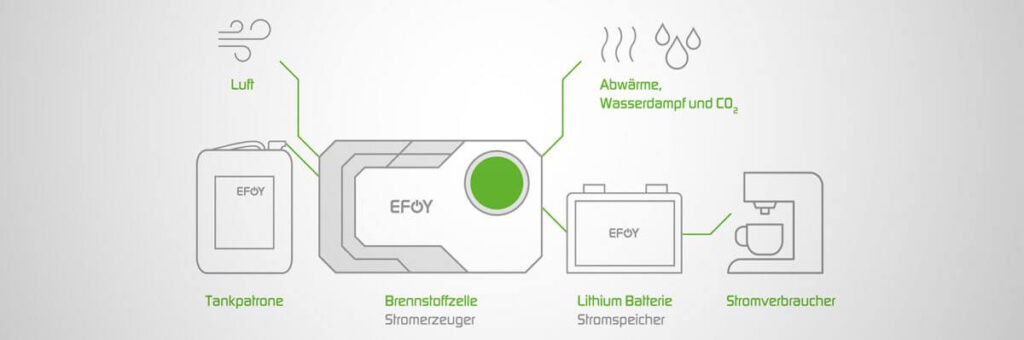
The EFOY fuel cell is based on so-called direct methanol technology (DMFC). Chemical energy is converted directly into electricity – without any complicated intermediate steps or major energy losses. The fuel used is methanol from a practical fuel cartridge, which generates electricity together with oxygen from the ambient air. Apart from electricity, only a little heat, water vapor and small amounts of CO₂ are produced. An efficient and particularly environmentally friendly solution!
The heart of the EFOY fuel cell is the so-called stack – a stack of individual cells. Each of these cells consists of an anode, a cathode and a membrane in between. This membrane acts as a separating layer and only allows positively charged protons to pass through. Methanol and water are added at the anode and oxygen from the ambient air at the cathode. During the reaction, protons (H⁺), free electrons and CO₂ are produced at the anode. The protons migrate directly through the membrane to the cathode, while the electrons flow around the outside of the connected circuit and generate electricity. Protons, oxygen and electrons then combine at the cathode to form water vapor.
The methanol storage tank
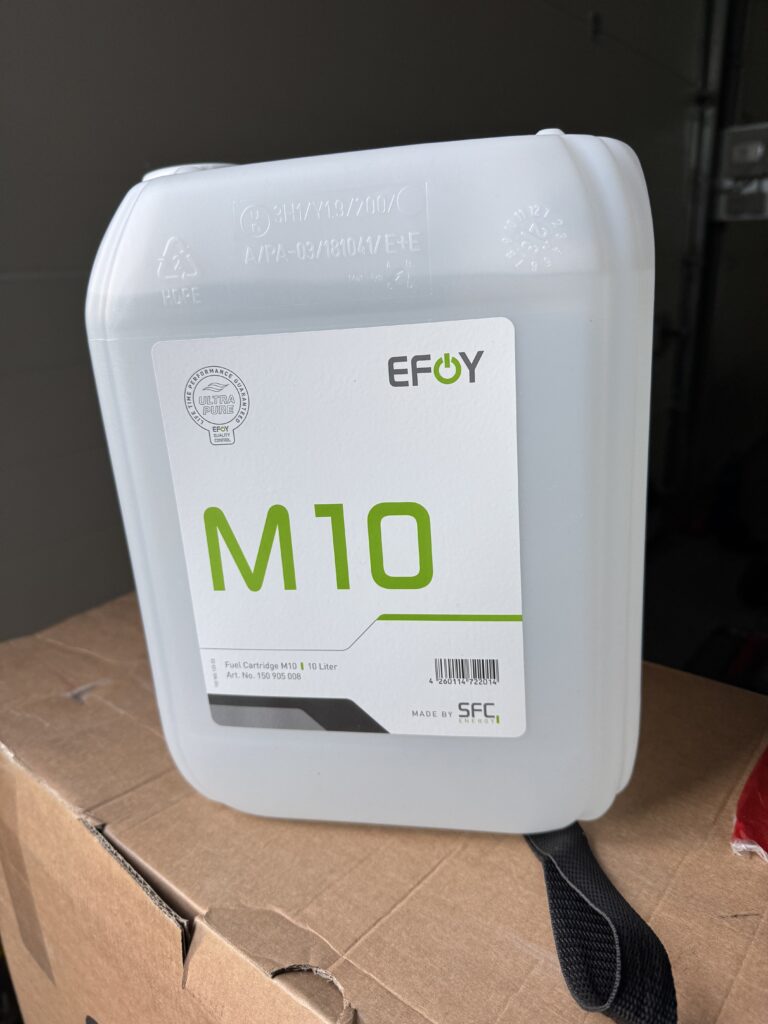
EFOY fuel cells require special EFOY fuel cartridges for operation. These are filled with high-purity methanol and have a specially developed, safety-tested closure system. Thanks to this safety seal, you do not come into contact with the methanol and can change the cartridge in a flash. Simply unscrew, screw on a new cartridge and you’re done!
The fuel cartridges are available worldwide in two sizes (5 and 10 liters) from authorized camping and marine dealers.
How much methanol does the EFOY 2800 consume?
In addition to air, the fuel cell requires methanol, as described above. The EFOY 2800 consumes 0.9 liters per kilowatt hour. If you run the EFOY for 24 hours without a break, this corresponds to a nominal consumption of 2.4 liters of methanol per day. With an M10 fuel cartridge, the fuel cell can generate electricity non-stop for four days.
Installation of the EFOY
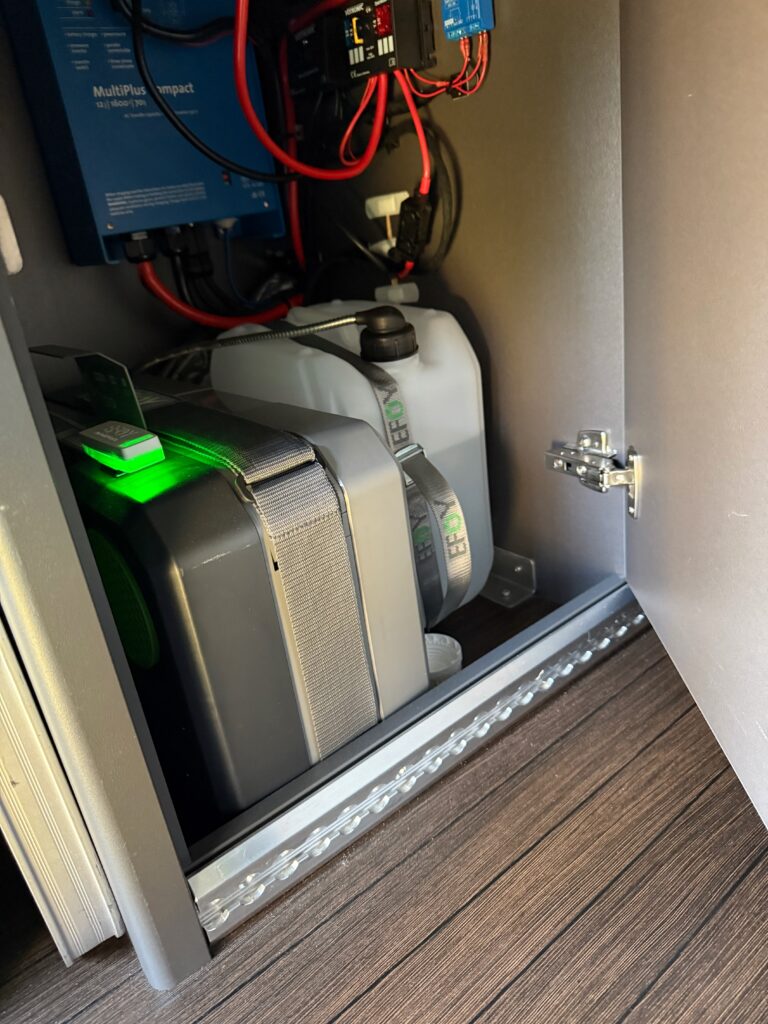
We decided to install the fuel cell in one of the cupboards in the rear garage. The space was ideal as we had already installed the third battery and the second inverter there. This meant that the cabling could be installed quickly and easily.

We simply discharge the resulting ‘waste water’ via the forced ventilation in the rear of our Cali. The heat can easily escape from the cupboard via the openings on the outside shower. However, I can imagine that it will get too warm in the cupboard in summer and we will therefore have to provide additional ventilation. We will implement this in the form of ventilation grilles in the door.
Cost EFOY 2800 Pro
Over the past few minutes, you have gotten a first impression of the EFOY 2800. I’m sure many of you are wondering: How much does the EFOY 2800 cost?
The fuel cell from SFC is not cheap – around 8300 euros are due for the 2800 version. Methanol canisters are also required. The 10-liter version costs 60 euros, the 5-liter version 40 euros.
We installed the EFOY in our Grand California in December and have since undertaken two major trips with it on board. It has given us maximum independence, especially in the Swedish winter. Far above the Arctic Circle, the sun never rises in winter and electricity consumption is probably never higher than under these conditions. Even when it was minus 30 degrees outside, we were able to generate electricity reliably.
Normally I always pack everything into a single report, but in this case I decided to write a separate article exclusively about our test of the EFOY. In it, I’ll go into detail about how the app is operated, how loud the fuel cell actually is and other important points. If you are interested in this topic, please continue to follow our blog and if you have any questions about the EFOY, feel free to send us an e-mail or leave a comment.


2 comments
What a brilliant product. Can’t wait for part 2.
Awesome that you liked the post 🙂
We’ll upload part 2 as soon as possible.
Best regards