

We haven’t written about our toilet for a while, 💩 so it’s about time.
We have been very happy with our ToniTT for the last two years and have probably used this toilet more often than most people would. We had known about the Clesana C1 for some time, but never considered it because we were also more than satisfied with our ToniTT.
Until the Caravan Salon this year… By chance, we ended up at the Clesana stand and the owner had just started a demonstration of the toilet. The okay we’ll just listen for a moment turned into a full hour and what can I say, we were immediately convinced and enthusiastic that the Clesana was the toilet we wanted in our Grand California.
Now you’re wondering why, right? Before I go into the functions and installation in this article, I will answer this very question.
Basically, we were very satisfied with our ToniTT, but there was always a small but. Due to intensive use, especially in summer, there were sometimes distinct odors in the vehicle. We were able to get the whole thing under control with the help of an activated charcoal cover and the use of a lot of soil . Nun There was of course the option of always doing the big business in a bag and disposing of it directly, but for us that defeated the purpose of a dry separation toilet, because then we could have stayed with the standard toilet and simply used an insert for a bag.
Regardless of any odors, I was simply fed up with handling faeces and exactly that unfortunately cannot be avoided with a dry separation toilet. Don’t get me wrong, the idea and concept behind composting toilets is great, but the business has to get out of the vehicle somehow. When the solids bucket was full, the contents had to be put into a bin liner and then disposed of. Depending on how long ago the business was done, this was more or less nice…. Nevertheless, not using a chemical toilet was absolutely the right decision, because a separate toilet gave us maximum freedom on our travels, especially in Sweden.
In the end, the store ended up in a plastic bag, which then ended up in the residual waste. It’s actually completely absurd, isn’t it? …that was always my biggest argument against the Clesana, because in the end you don’t do anything differently there.
As mentioned above, our opinion changed at the Caravan Salon. Of course, bags are required for the big business, but after the toilet session is over, I simply throw my toilet paper to my business, just like in a normal toilet, press a button and a few seconds later the whole mess is odorless. and welded opaque.
Another small detour on the subject of toilet paper: we always disposed of it separately in a small garbage can when we used our separate toilet. This was another point that bothered me personally.
Okay enough of the introduction as to why we changed our toilet, let’s talk about a few facts about the Clesana.
Clesana function
The function of the Clesana is actually totally simple, but just as ingenious. Before the toilet can be used, the so-called foil liner must be inserted, which can be imagined as a bin liner without a base. After using the toilet, the user can choose between four different bag sizes: XS, S, L or XL. For example, an XS bag is sufficient for a toilet visit where only urination takes place. This increases the service life of the film liner accordingly. Using the standard bag sizes, a fresh foil liner can be used for up to 38 small (S) or 26 large (L) toilet visits, while the extra small bag (XS) function allows the liner to be used for up to 52 toilet visits.
Once you’ve done your business, close the lid, select the right bag size on the display and the Clesana will start sealing the bag.
Once the bag is sealed, it ends up in a collection container located directly under the toilet. This drawer can be easily opened from the inside and the full bag removed, leaving absolutely no odors.
What can I say, that’s it.
A few facts about Clesana
The basic idea
Did you know that Clesana, or at least the basic product, actually comes from the medical or hospital sector? The founders’ idea was to develop a hygienic toilet for sick or infectious people.
The barrier film of the Clesana does not allow any germs to escape, which makes the product indispensable when dealing with the above-mentioned groups of people.
This is what Clesana writes on its own homepage:
Medical hygiene standards are part of Clesana’s DNA. This is because the revolutionary functional principle of the Clesana C1 is based on medical technology. Originally designed for a project by the Swiss Federal Office for the Environment to protect water from contamination by drug residues, hormones and other chemicals, the Clesana system is already being used in clinics today. Driven by this surge in innovation, the technical components have been continuously developed for use in many other areas, from caravanning to shipping, from care for the elderly and sick to civil defense, at home or far away. As a result, the Clesana C1 meets even the highest hygiene requirements – so you don’t even have to ask yourself how high your standards actually are.
You are independent
The Clesana C1 gives us maximum independence. No disposal station? No problem!
As the toilet works completely without water, which is why it is also called a dry toilet, you only need foil liner for your vacation. The bags are disposed of with the residual waste and, as there is no odor, the bag can even remainin the car for a long time until the next waste garbage can, up to four weeks according to Clesana.
But how is the toilet operated?
You’ve already guessed it, sealing the bags doesn’t work with air and love. Perhaps this is a function of the future C2?! 🤣...Joking aside .
You need electricity for the system to work. Not a lot, but a little. The Clesana is connected to your body battery and requires 0.55Wh for each toilet visit, Clesana refers to this as sweating.
55 what?!? Watt hours 🙂 Let’s take the standard AGM battery of the Grand California, which has a capacity of 92Ah, as a benchmark to classify the power consumption .
A 92Ah AGM battery has a capacity of 1104 watt hours (92Ah × 12V). As AGM batteries should not be fully discharged to avoid damage, the usable capacity is between 50% (equivalent to 552Wh) and 70% (equivalent to 773Wh), depending on the depth of discharge (DoD).
This means you can safely use between 550 and 770 watt hours from a 92 Ah AGM battery.
Let’s be conservative and calculate with 550 watt hours, which means you can seal 1000 bags non-stop with one battery charge. Of course, the toilet still has a standby consumption of 0.28Wh. So if you didn’t use anything in the vehicle and only operated the toilet in standby mode, it would take no less than 81 days for the battery to run out.
This means that even with an original AGM battery, the power consumption is not worth mentioning. For example, if you have installed a 300Ah self-sufficient package from Car Electric, you could operate the Clesana in standby mode for 535 days without charging the batteries once.
Environment and all that? 🌲
First things first, nothing can beat the environmental footprint of a composting toilet, but only if you don’t use it with bags, of course. Or not? The statement always assumes that the faeces are disposed of properly.
But what about the Clesana, where plastic bags are used for going to the toilet, which creates a lot of waste.
This is what the manufacturer writes:
We know that many people believe that being environmentally conscious means doing without. But with the Clesana C1, we prove that genuine sustainability and top performance can go hand in hand.
The outstanding environmental compatibility of Clesana becomes particularly clear when we look at the life cycle assessment in its entirety, i.e. from production through use to disposal. In doing so, we rely on the proven ReCiPe* assessment method, which aims to evaluate the impact of products on people and the environment as a whole.
The corresponding analyses have shown that Clesana performs significantly better than conventional chemical toilets in all key environmental impact categories – both in terms of climate change and with regard to soil acidification, water pollution and, last but not least, potential health risks for humans. For example, Clesana’s CO2 footprint is already 10% lower than that of chemical toilets. And we are consistently working on making our hygiene solutions even more environmentally friendly.
In direct comparison with the conventional chemical toilet, the Clesana C1 clearly performs better in all effectiveness categories:
- 1. up to 10% lower CO2 footprint [kg CO2e] with the barrier film liner
- 2. up to 124% reduction in soil acidification [kg SO2e]**
- 3. up to 63% lower ecotoxicity in water [kg 1,4-DCBe]**
- 4. up to 115% reduced toxicity for humans [kg 1,4-DCBe]**
- 5. approx. 170 liters of water saved as a valuable resource
For comparison: 5 toilet visits*** with barrier foil only correspond to the CO2 footprint left behind by the production of 1 glass of wine (0.2 l) or 2 bottles of beer (0.33 l). Or a journey of 1.4 km in a camper van (Fiat Ducato 130 Multijet, diesel, Euro 6). This is innovation as we understand it: good for people and good for nature.
* Developed in cooperation between the Dutch Institute for Public Health, the Universities of Nijmwegen and Leiden and analysts from the sustainability agency Pré. **through the residue-free incineration of substances that cannot be processed in wastewater treatment plants. *** corresponds to the average number of uses per person, per day.


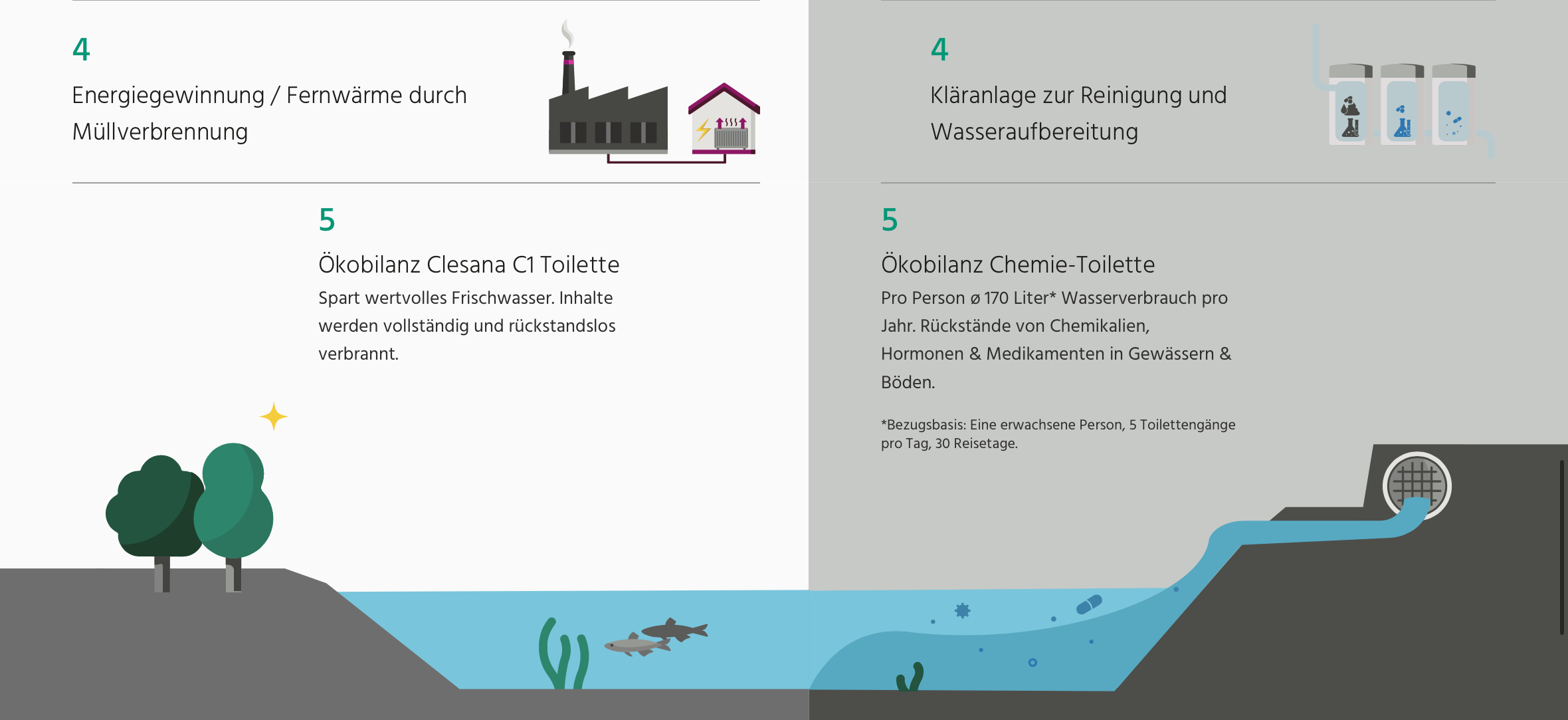
So let’s take the manufacturer’s word for it that the Clesana C1 and its bags are more environmentally friendly than a chemical toilet. The film used by Clesana is made from plant-based and therefore climate-neutral polymer.
What does plant-based and therefore climate-neutral polymer mean?
Plant-based polymers, also known as bio-based plastics, are materials that are made from renewable raw materials such as corn, sugar cane, cellulose or algae. These polymers offer a sustainable alternative to petroleum-based plastics and can be used for films, packaging or textiles, for example.
What makes plant-based polymers climate-friendly?
-Renewable raw materials: During growth, the plants bind CO₂ from the atmosphere, which improves the CO₂ balance.
-Reduced fossil dependency: Since these polymers are not made from crude oil but from plants, the use of fossil resources is minimized.
Climate neutrality: Many plant-based films are climate-neutral in their life cycle analysis, especially if they can be recycled or composted at the end of their life.
Properties and areas of application
Flexibility and strength: Plant-based films can be just as resistant and flexible as their fossil counterparts.
-Biodegradable: Some variants, such as PLA (polylactic acid), can be industrially composted.
-Wide range of applications: Suitable for food packaging, agricultural films or even technical products.
Challenges
-Costs: Production is currently often more expensive than for conventional plastic.
-Infrastructure: There is a lack of sufficient composting facilities and recycling systems to make optimum use of the materials.
-Use of raw materials: The cultivation of plants for polymers must not compete with food production.
Conclusion
Plant-based polymers are a step towards sustainable packaging solutions and an important contribution to reducing the ecological footprint. With further technological advances and a stronger focus on the circular economy, this approach could be a key building block for a climate-friendly future.
Installation in the Grand California
The old toilet has to be removed, the power cable laid, the Clesana and the new control panel installed. Ah, and last but not least, you need to apply new silicone grouting around the base of the toilet.
Sounds like a 5 minute job doesn’t it? I thought about attaching installation instructions to this post, but in the end I decided against it. The intervention in the vehicle is greater and anyone who undertakes this conversion should be familiar with the matter.
Clesana offers a so-called L-adapter for installation. With the aid of the adapter, the C1 can be fitted in any vehicle in which a Thetford C220 was previously fitted. There is one thing to bear in mind: the omission of the toilet cassette creates a hole between the bodywork and the interior of the Grand California, which can be seen in the pictures below. We made adapter plates to close this gap. As we have already received some questions via Instagram, you can order the plates to close the gap from us on request.


Theoretically, the conversion can be completely reversed. The rear wall in the bathroom has to be cut out for the new control panel, which means that the Thetford flush switch would no longer fit if the conversion was reversed. In this case, a subframe would have to be built.
Conclusion & costs
Of course, it is far too early to give final feedback, as we have only been able to test the toilet on a short trip. However, our first impression is very positive and confirms our decision. We will certainly provide another review here after a few months.
The installation takes about 6 hours, please remember not to move the vehicle for at least 24 hours so that the silicone can dry through. As we did the entire installation ourselves, I can’t say anything about the costs at a dealer, but assuming an hourly rate of around 100 euros, it will certainly cost 800 euros including materials. This brings the total price of the system to around 2200 euros.
The cost of foil is 25 euros for an average of 80 toilet visits, which corresponds to 30 cents per bag. These costs can be reduced even further if you opt for the optional urine container. This is inserted into the Clesana and only used for urine. After use, it can simply be emptied, so no bag is needed for the small business.
We filmed our commissioning, so you can take a closer look at the toilet and how it works.
If you have any questions about installation or function, just get in touch with us.

