

Over the last 12 months we have had the pleasure of testing a number of lithium batteries in the Grand California, starting with a 100Ah battery from Wattstunde, a 100Ah Supervolt and ending with a 150Ah also from Supervolt. Every single one of these batteries has done its job in the Grand California, never was there a situation where we ended up without power.
Whether watt-hour or supervolt with all batteries, we had to live with a few limitations:
- The display in the camper unit no longer works, a charge level of 100 percent was always displayed there. This is due to the fact that the control unit of the Grand California is set to an AGM battery. This can also not be changed, because a change in the software of the control unit is necessary. No coding or the like will help here.
- To ensure that the battery is charged, the battery button must always be pressed while driving.
- If you turn the switch off again while driving, the body battery is discharged with 50A by the isolating relay. To avoid this, the engine must first be switched off.
- The charging current is much too high. The Grand California charges the body battery with up to 200A, the batteries we tested all have a maximum charging current of 100A. The built-in BMS in the batteries ensured that the batteries were not subjected to this high current, but this did not provide a continuous charge. The sequence was always the same: The battery starts charging, the current shoots up. At over 100A, shutdown by the BMS. This was repeated until a charge of around 80 percent was reached, after which the Grand California regulated the current down automatically.
The fourth point can be circumvented by changing a coding on the vehicle. So it is possible in the control unit 19 (gateway), which is something like the boss in the vehicle, to change the battery type to lithium. This limits the charging current to 80A and eliminates problems with charging currents.
We had written instructions on how to do this here:
https://grandcali.com/codierung-grand-california/
But even this variant has a disadvantage in the long run, AGM and lithium batteries have a different final charging voltage. Some of you may have guessed at this point that the starter battery in the Grand California is also an AGM. Not only does the charge curve no longer match the battery, but the voltage is no longer sufficient to prevent the battery from sulfating. Of course, this does not happen overnight, but it is definitely a point to keep in mind. This should just be mentioned, so the coding is not inconsequential.
We can argue about crash safety or temperatures under the hood at this point, we had also dealt with and explained these topics in the past. However, there is one thing that absolutely cannot be talked away, if you replace the battery with a lithium plug and play, you will most likely lose the complete warranty on the electrical system in the Grand California in the event of damage. Volkswagen is merciless on this point. Those who no longer have a warranty and can cope with the above-mentioned restrictions will do well with it.
Car Electric from Hamburg
Now there is a company in Hamburg that promises to lift all these restrictions and do it all while maintaining the full warranty. Car Electric, or rather the conversion of Car Electric, is the first and only one that has a certificate of no objection from Volkswagen. This means that even after the conversion to lithium, your vehicle will retain the factory warranty. As if that wasn’t enough, the camper unit display also works exactly the same with lithium as it does from the factory. This is achieved by a new software for the control unit, in which the corresponding values for lithium batteries are stored. If your Grand California is converted at Car Electric or one of the installation partners, the conversion is stored in the Volkswagen system. This point is important, because if your vehicle needs a new control unit, for example, the appropriate software is automatically installed by Volkswagen, since the conversion is stored as equipment in the vehicle data.
We will go into the details of the conversion in more detail later on.
We also knew about the Car Electric conversion before our first battery test, but with costs of at least 5000 euros, the conversion was too expensive for us. Actually, it is obvious, a few restrictions and you save 4000 euros. In our opinion, the proof that a plug and play swap works has been shown after more than a year in use. However, we were curious, why does it cost 4000 euros more at Car Electric and what exactly do they do anyway!
So we contacted Car Electric and to our surprise they were already aware of our blog and testing. After a few conversations we met in Essen at the Camping Fair in Essen. Bendix from Car Electric took the morning to show us the conversion on a Grand California.

So we wanted to know, why would a Grand California owner choose the Car Electric conversion over the plug and play swap? In addition to the main argument, the preservation of the warranty, materials used and the place of installation were also addressed. For example, the SuperB battery used alone costs around 2200 euros.
Okay, so only top products of very high quality are used here.
After the conversation our dilemma was complete, on the one hand we have always advocated that a plug and play swap is sufficient. But on the other hand, curiosity was aroused. Testing a single battery is of course much easier than a complex modification on the vehicle. Of course, we could have gone to Hamburg, Car Electric installs the setup for us and we write a nice report saying how much better this conversion is. Of course, this would have the bad taste that we could be accused of a lack of neutrality. After all, we would have received a conversion for 5000 euros to test it. Certainly, this can also be (almost) deconstructed again, but of course not as easily as a single battery.
Silvie and I have made it our mission to report as independently as possible in this blog. Therefore, it was clear to us that we could only write a report about the self-sufficiency package from Car Electric and evaluate the conversion if we had it carried out ourselves. After a few days of consideration, we decided to have the self-sufficient package installed in our Grand California. To emphasize the matter again quite clearly at this point, we paid for the conversion ourselves and did not get it for testing. Thus, there is also no pressure here to report favorably!
Many readers of our blog have asked us about this conversion and wanted to know our opinion, so we see it as an added value and enrichment for the community, because now we can report on both the plug and play variant, as well as the self-sufficiency package.
The self-sufficiency package at a glance
The self-sufficiency package always consists of a basic component:
The “Grand California Autarky Package” consists of a SuperB LiFePO4 battery with a fully usable 150Ah, mounted in the back of the technical cabinet. To ensure that this battery can be charged properly, a 70A B2B charge booster is installed. The installed SuperB lithium battery is able to communicate fully and faultlessly with the vehicle. For the communication of these, a new set of cables is laid along the original wiring harness. The battery is attached to the basic furniture without damage.
The price for the basic package is 4999 euros including installation.
In addition to the basic package, there are two further supplementary modules:
The “Grand California additional module body battery” makes it possible to install an additional SuperB LiFePO4 battery with fully usable 150Ah, mounted in the back of the technical cabinet, thus achieving a total capacity of usable 300Ah. This additional body battery is also fully supported and represented by the system.
Price 2999 euros including assembly.
The “Grand California additional module inverter” makes it possible to autonomously supply all factory-installed sockets via an inverter with up to 1600W. For a coffee maker, small hair dryer or travel kettle, this power is optimal. Thanks to the mains priority circuit integrated in the device, these sockets can continue to be supplied by shore power when it is applied. The charging power is increased from the original 15A to up to 70A by the charger integrated in the inverter. The device is also installed in the technical cabinet at the back.
Price 1999 euros including assembly.
If you order the self-sufficiency package with two batteries and an inverter, you have to transfer 9997 euros to Car Electric.
We had the basic package installed in our Grand California, including the inverter module. The complete package was out of the question for us because we want to continue using our EFOY fuel cell. This was integrated into the system as part of the installation. We were allowed to accompany the installation and document it for you.
Installation self-sufficiency package

On April 27, we had our installation appointment in Hamburg. Important for the installation of the self-sufficient package is that the guys from Car Electric have enough space. The entire driver’s side must be cleared, as a set of cables is laid from the front of the engine compartment to the rear in the technical cabinet.
The components at a glance
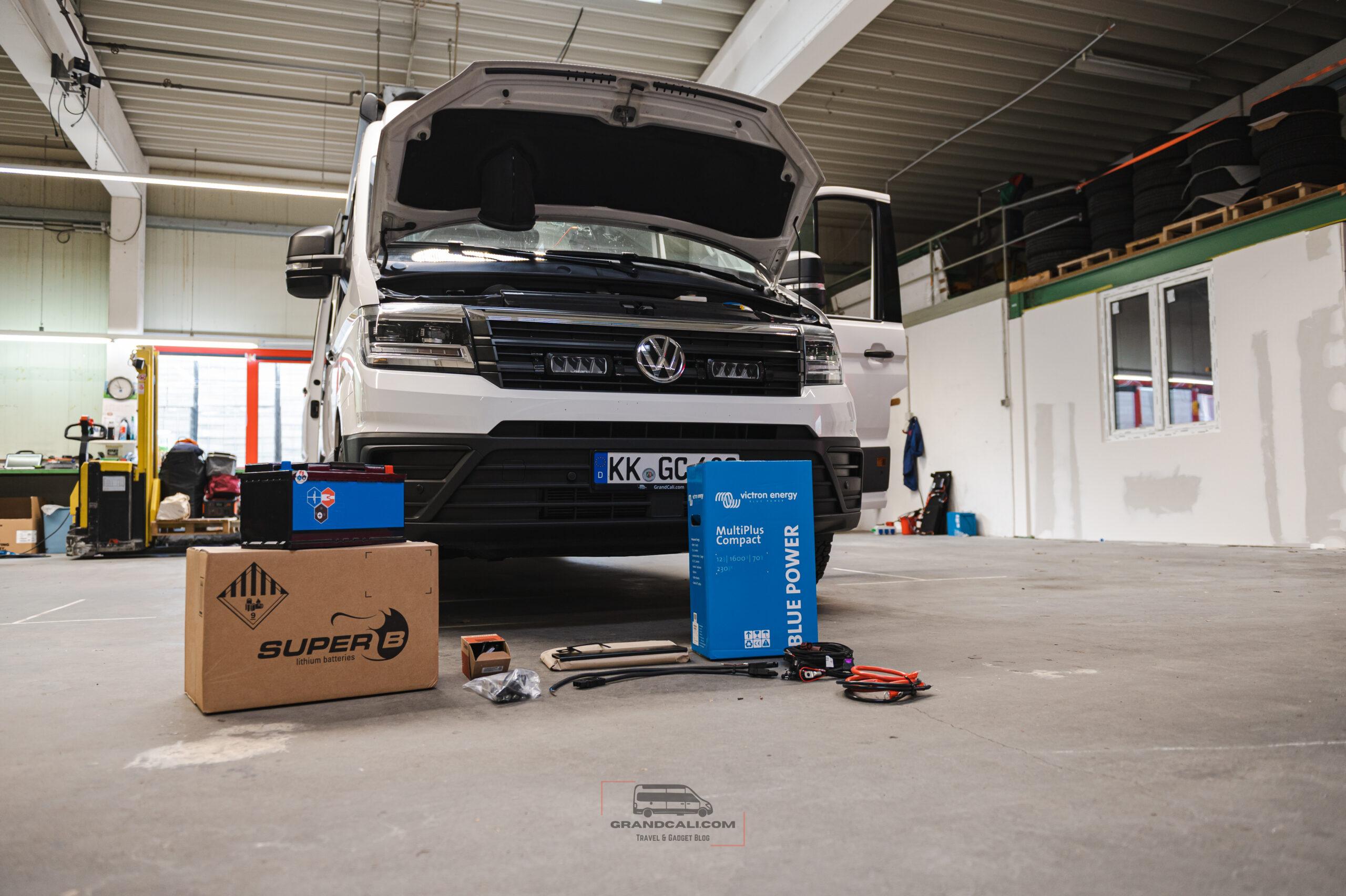

In the picture you can see all the components of the package. Actually not that much, right?
- Battery
- Inverter
- Charge booster
- Cable set
That’s it.
Mounting
New cable set

In the first step, the new cable harness is laid from the engine compartment to the technical cabinet. We had initially assumed that a new power supply would have to be created for the battery, but this is not the case. Car Electric uses the original wiring from the Grand California and runs a LIN Bus cable to the battery in the tech closet.


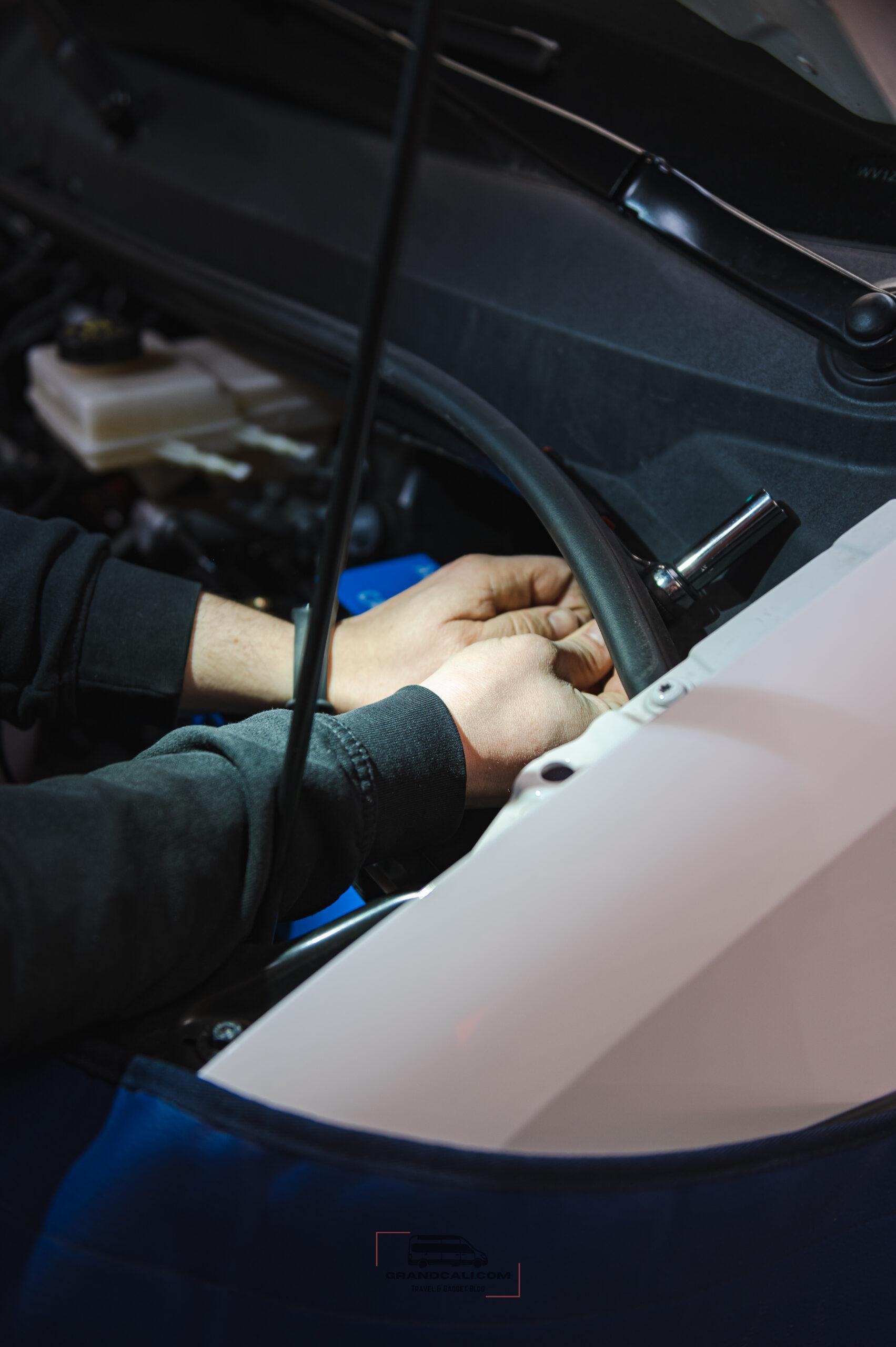


To do this, the B-pillar on the vehicle is dismantled and the cover of the heater is removed, after which pull-through aids are used. The laying of the new cables was done within 2 hours.
Installation battery empty housing / charge booster

As Car Electric installs the new battery and inverter in the equipment cabinet and removes the original AGM battery in the engine compartment, the resulting “hole” is filled with an empty battery case.
However, the battery case has a real highlight, because it is not empty at all: the 70A charge booster is housed here, which can charge the battery completely full in two hours. This means that nothing has to be screwed on or changed on the vehicle itself. We liked the idea incredibly well.

Preparations on the inverter
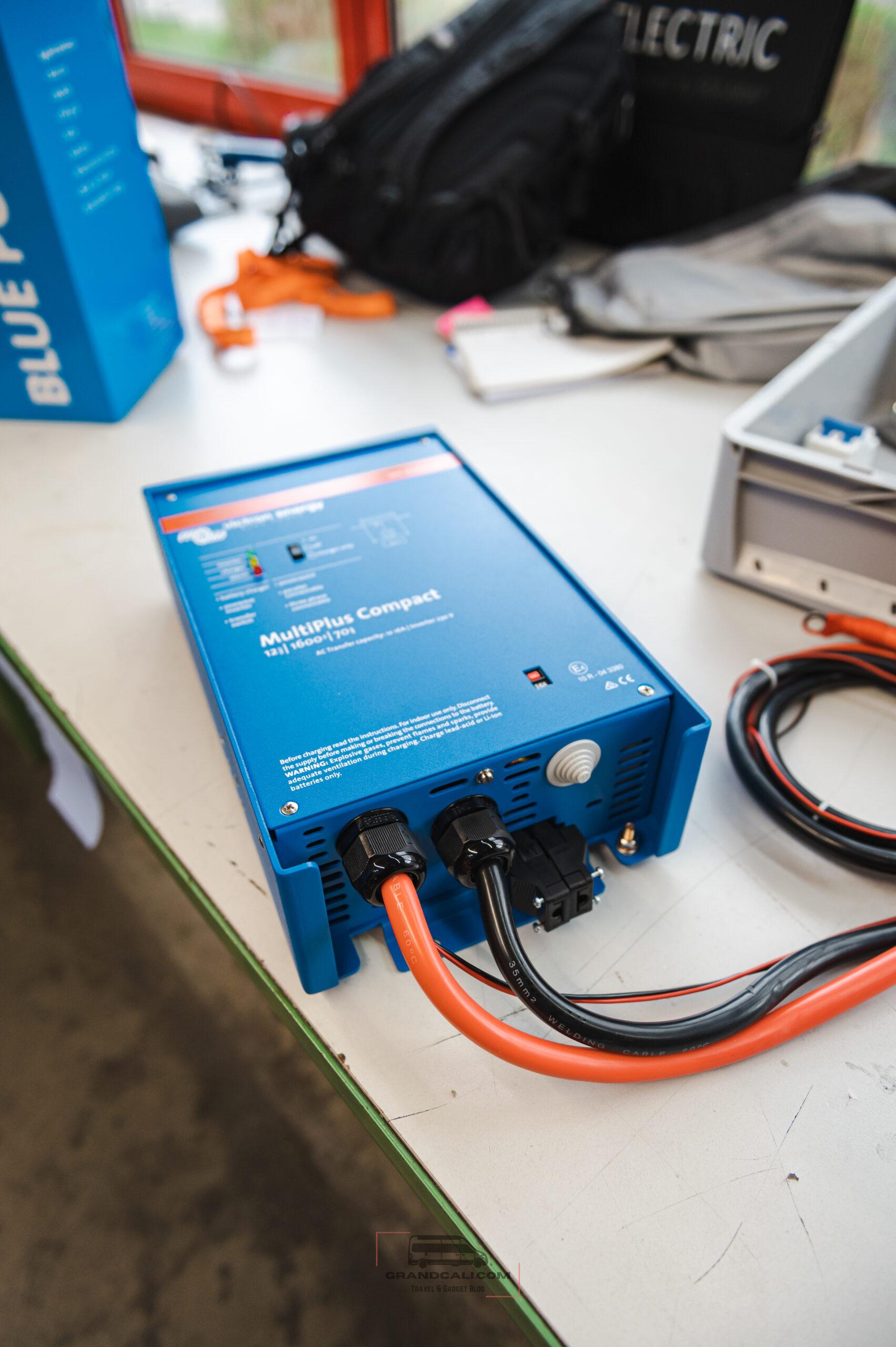
If you opt for the additional inverter module, you will receive a Victron MultiPlus Compact with 1600 watts. This allows you to use the 230 volt sockets in the Grand California even without shore power. In addition, the inverter has an integrated charger, thus the battery is charged on shore power with 70A instead of 15A.
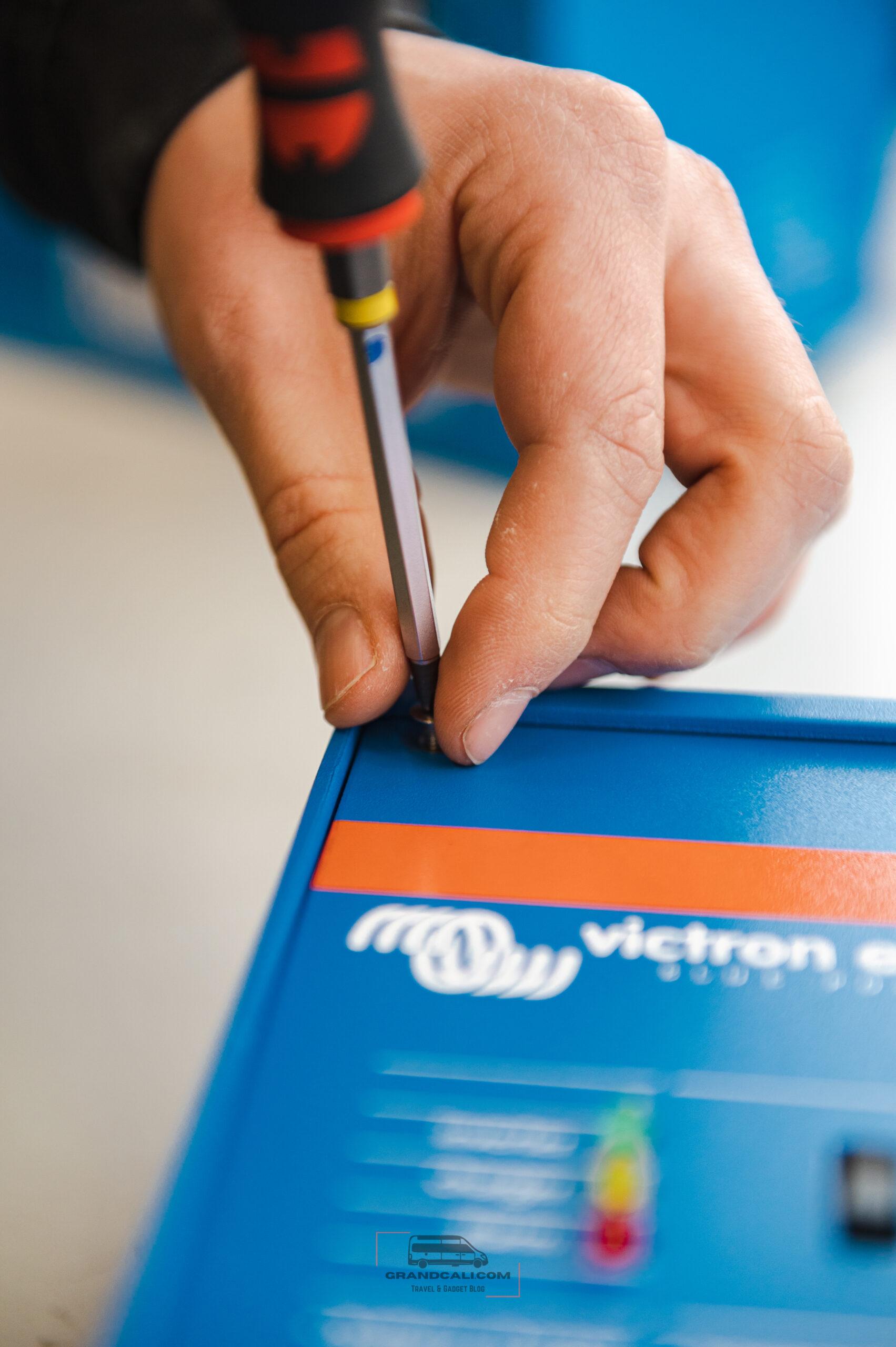
Before the inverter can be mounted, the charging curve is changed to lithium. For this purpose, a diagnostic cable is connected to the electronics and programming is carried out by means of a PC.
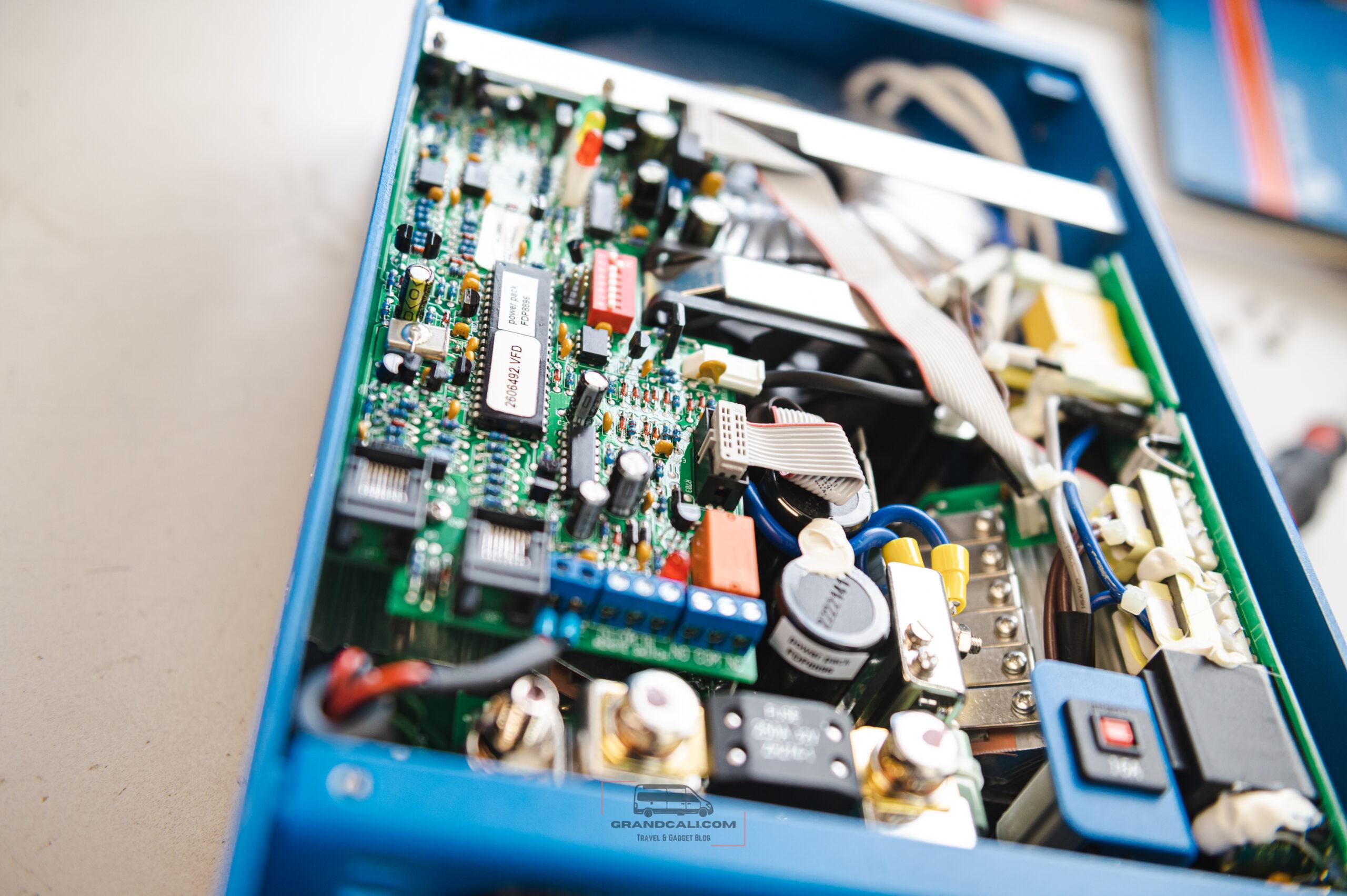

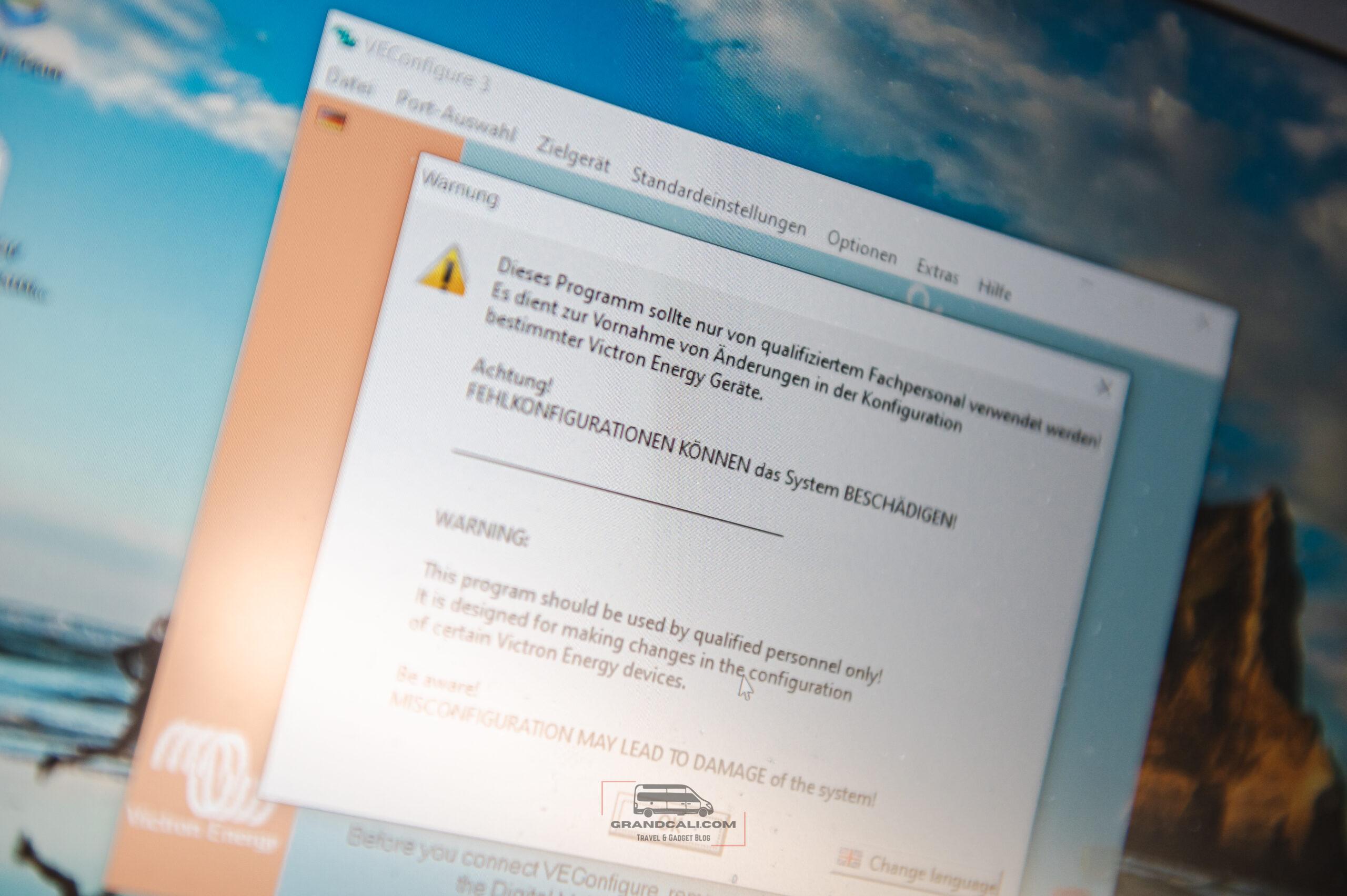

Reconstruction of the technical cabinet
To ensure that the battery and the inverter find a secure hold in the technical cabinet, the existing cabinet is modified and fitted with brackets.
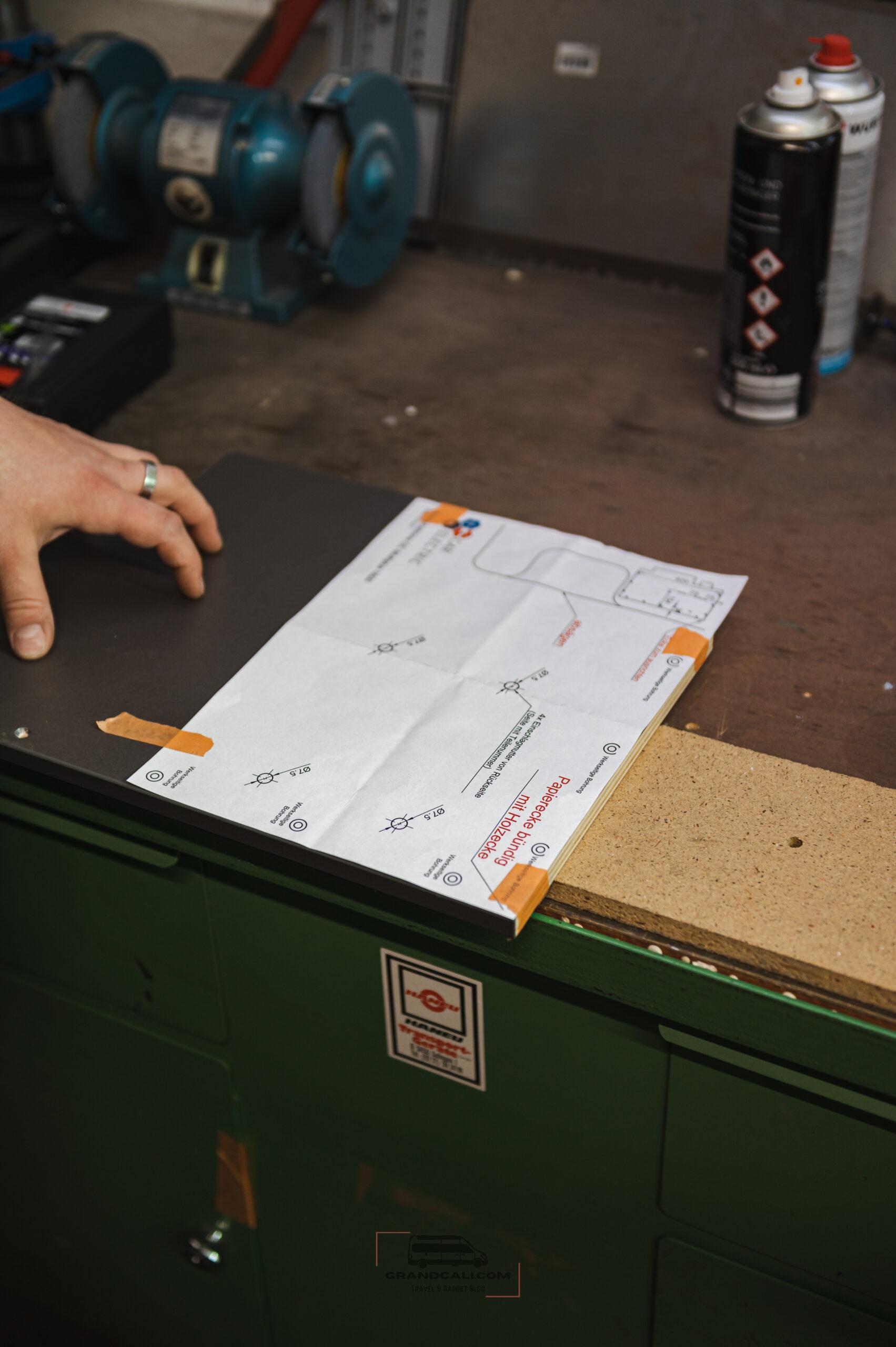
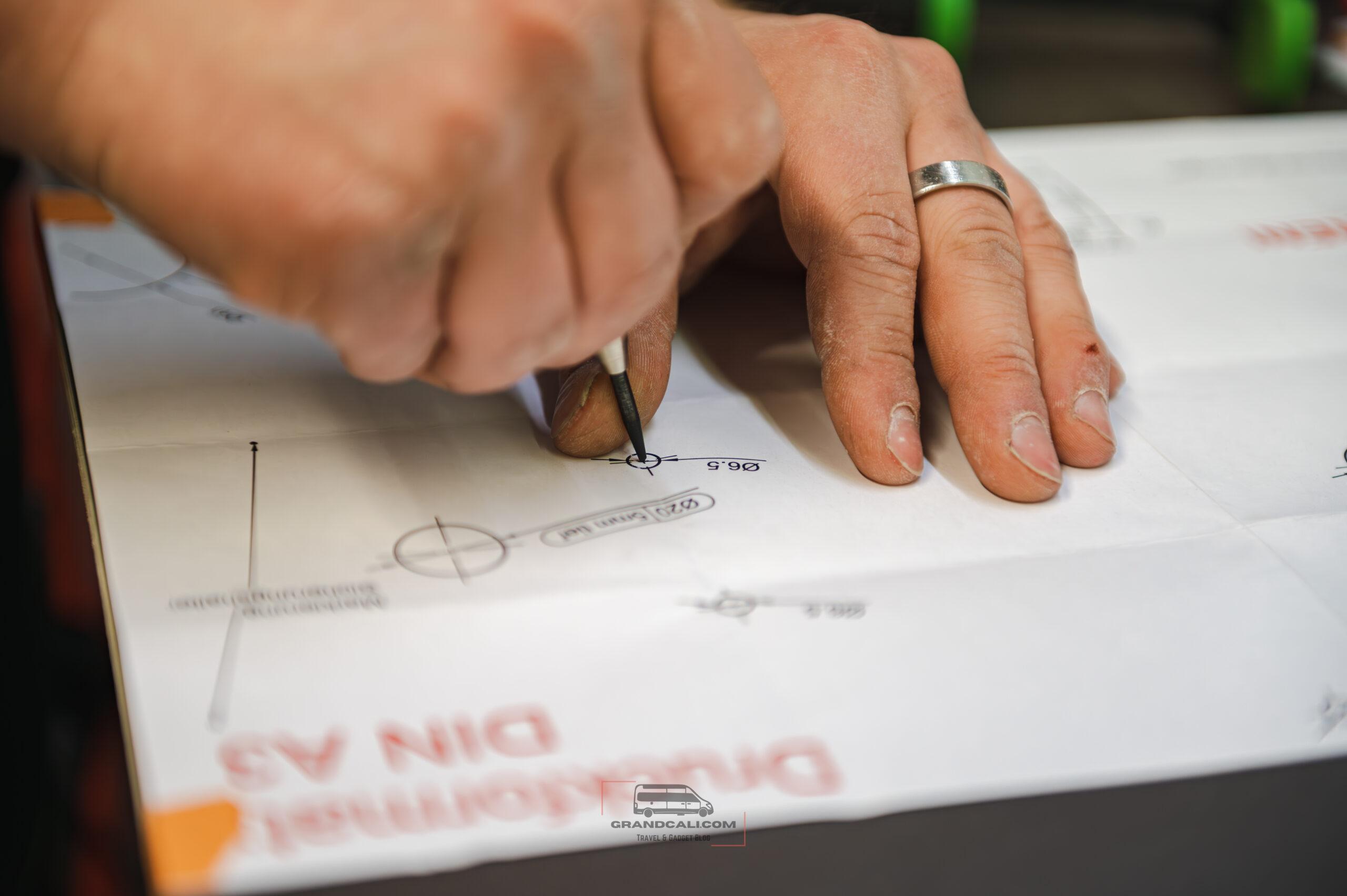
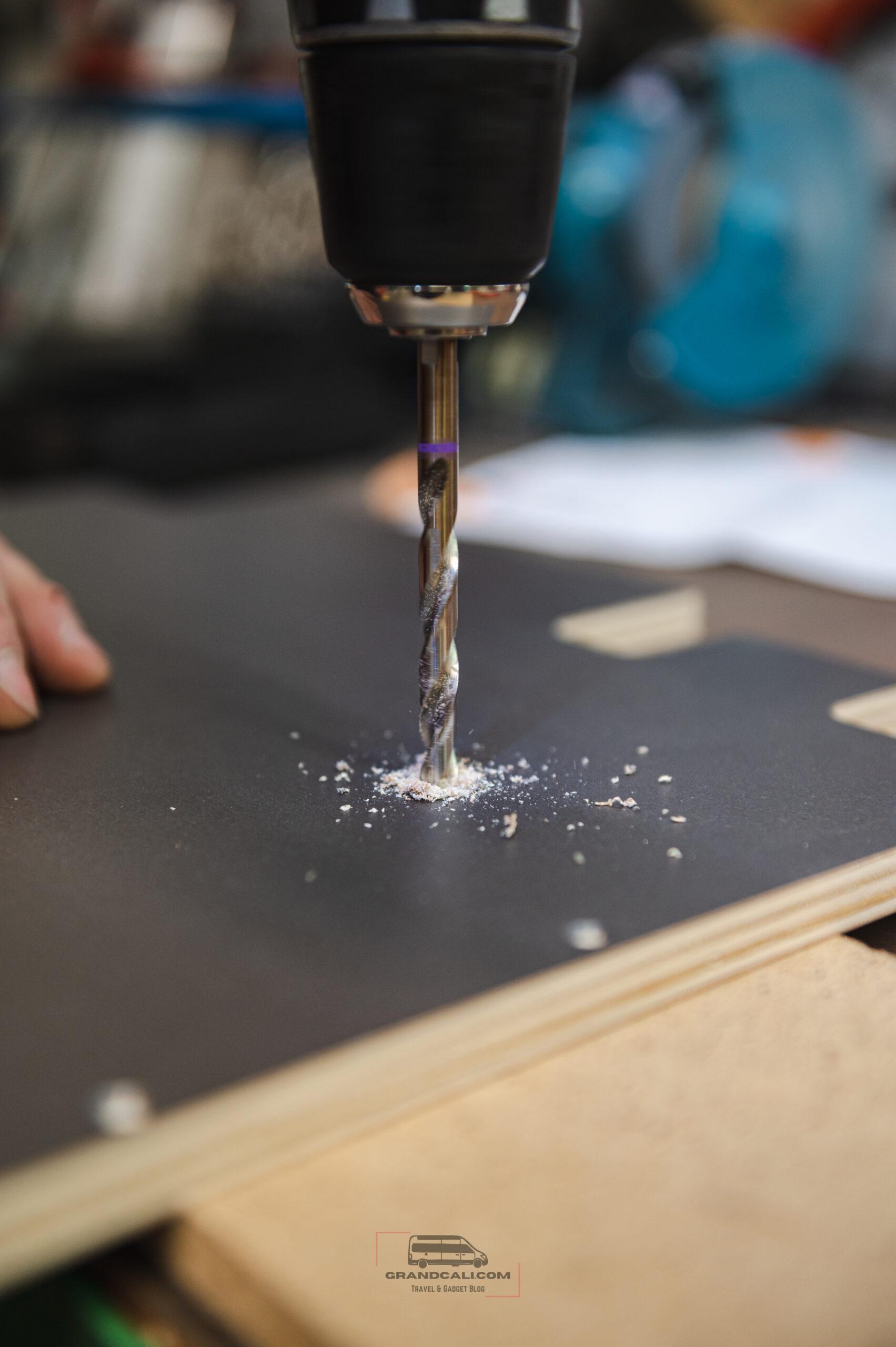
The boards are marked with the help of a template and subsequently drilled.

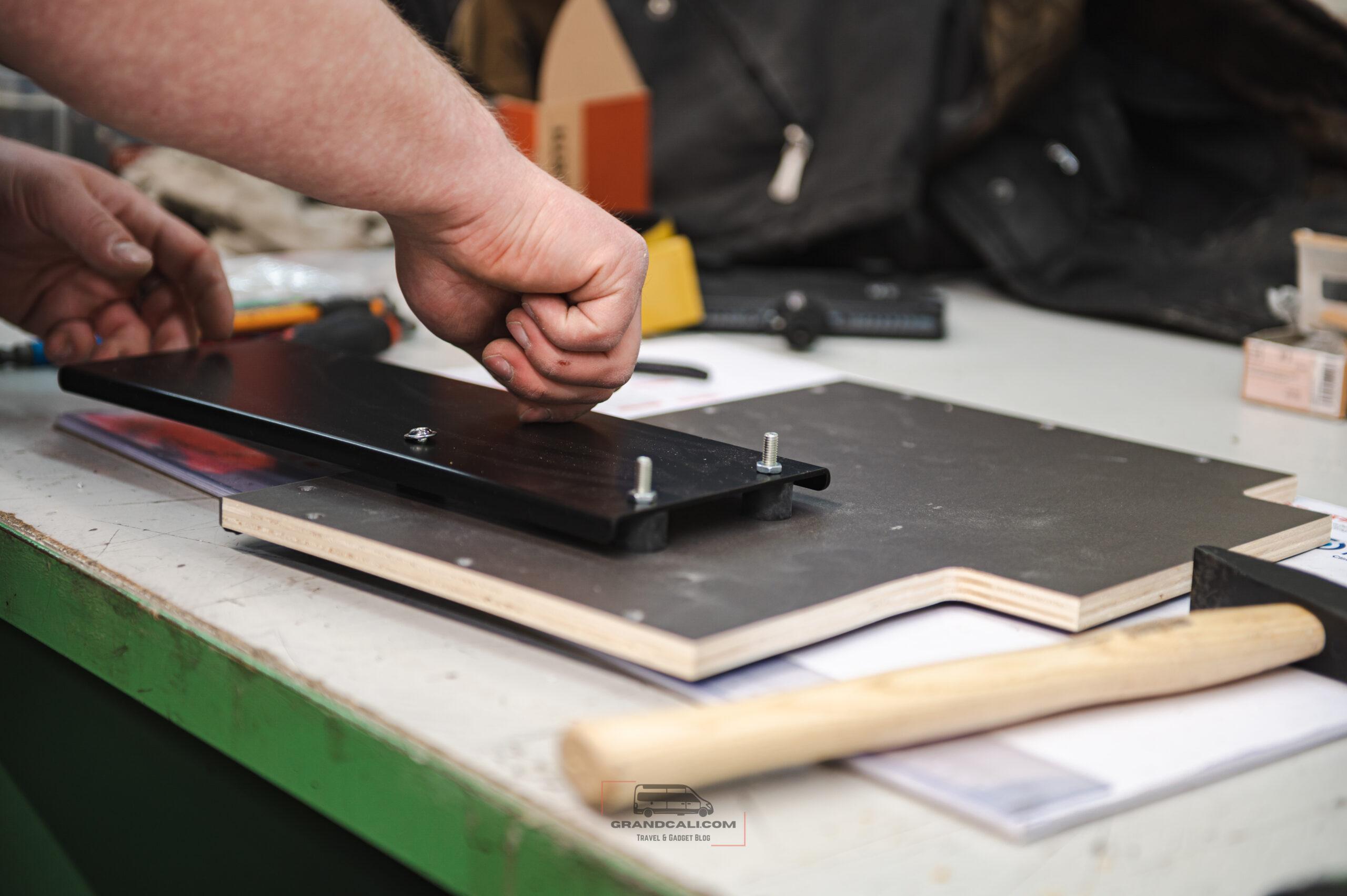
The last step is to mount metal frames so that the battery and inverter can not move from place.

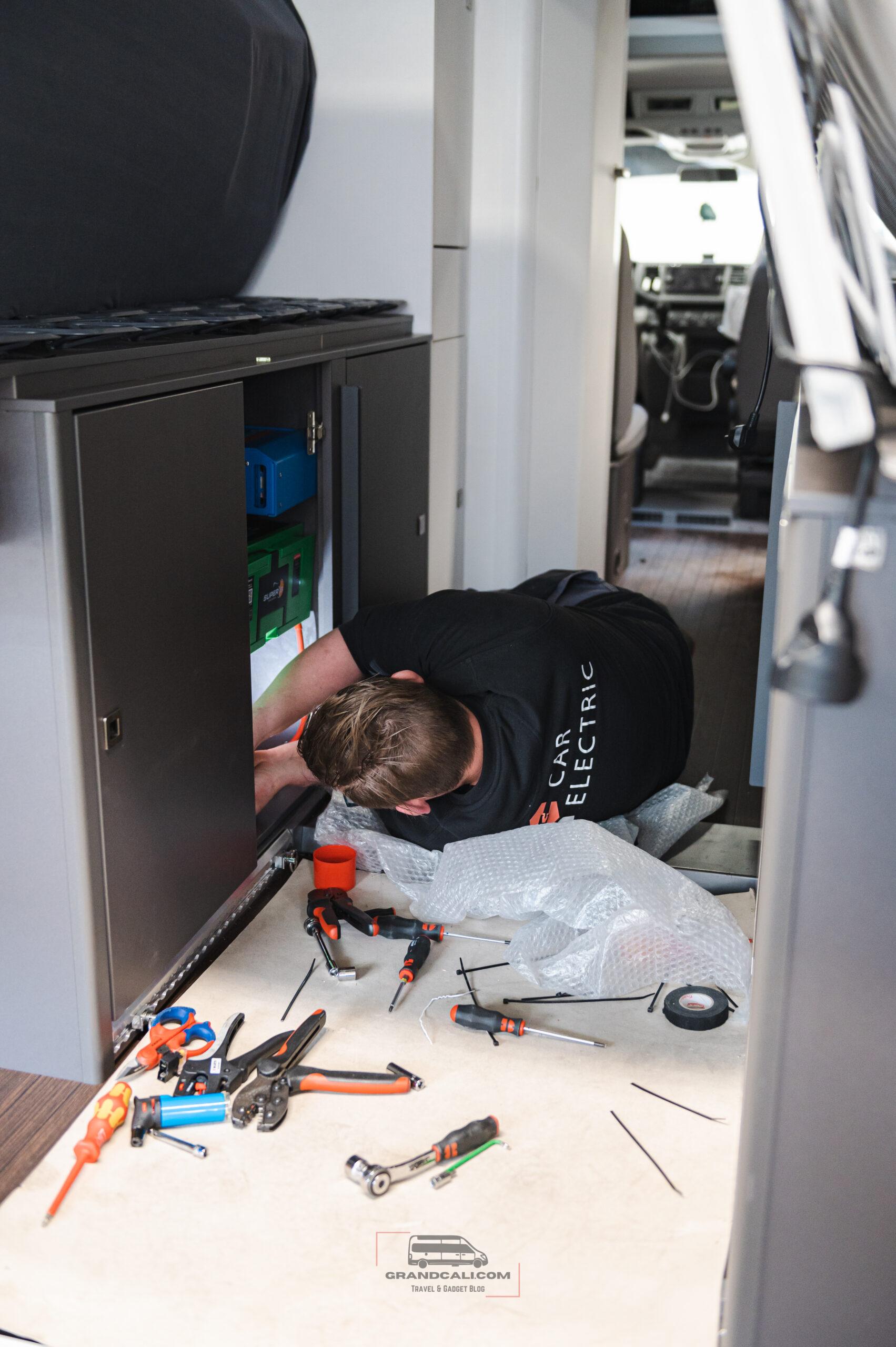
Once the boards are prepared and the frames are mounted, the last step is to perform the connection work in the technical cabinet.

Software customization
After installing the hardware components, the new software is loaded onto the ECU via ODIS (VW diagnostic system). Among other things, it ensures that the camper unit displays the correct values again. We have not documented this step further for data protection reasons.
Function after the in remodeling
Once all work has been completed, all vehicle functions are available again without restriction. This means that the battery is automatically charged to a charge level of 90 percent via the charge booster while driving. If you want a completely full battery, you have to press the familiar charge button in the dashboard to fill up the last ten percent.
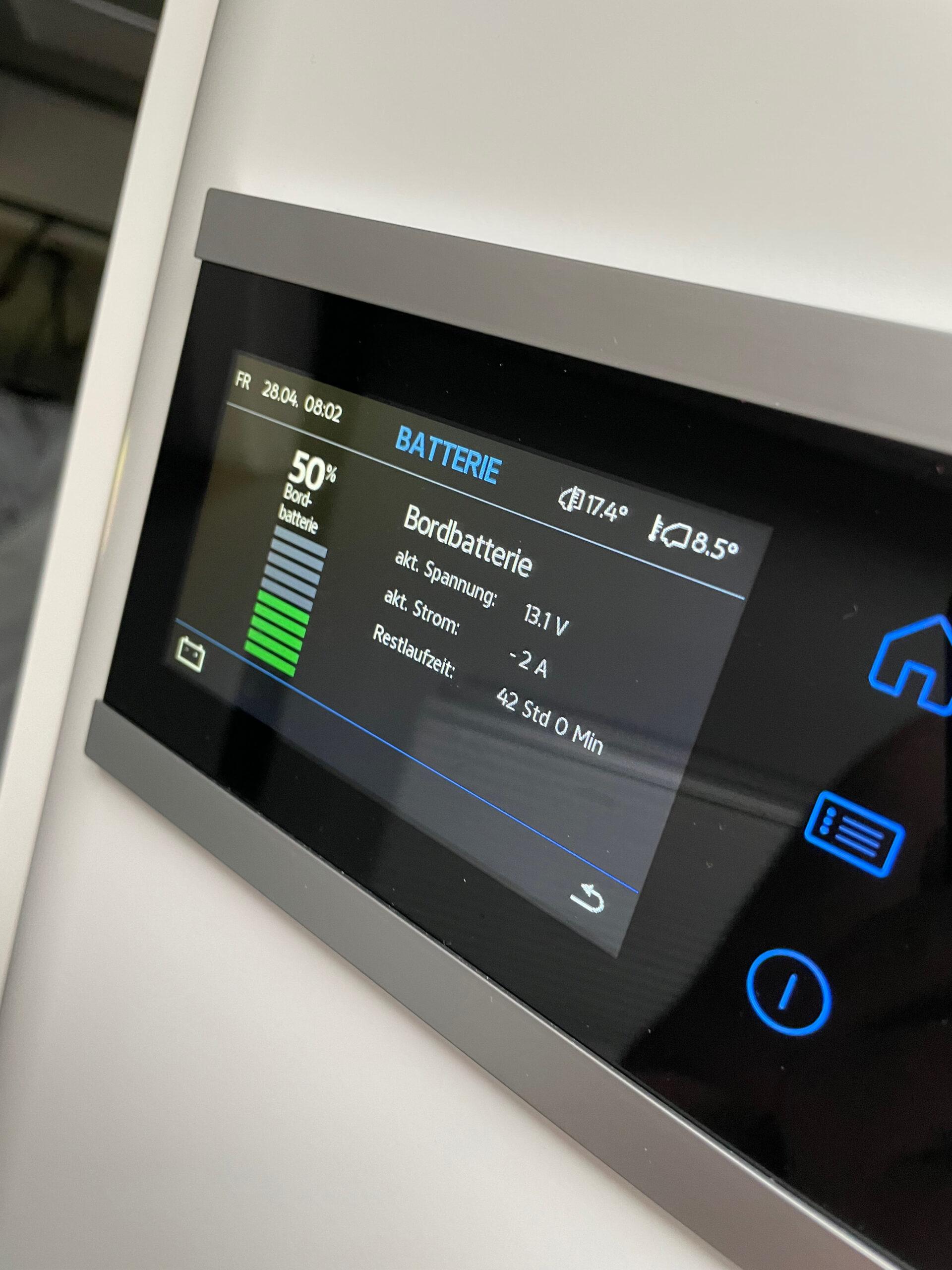
The display in the camper unit works after the conversion as from the factory and the battery charge is displayed correctly.
To use the sockets even without shore power, the inverter must be switched on. To do this, Car Electric installs a small toggle switch behind the dinette door.

A few thoughts in conclusion
From the first contact to the installation, we have rarely experienced something so friendly, competent and honest as with the guys and gals from Car Electric. Especially Bendix, Sören, David and Michael did a great job with the rebuild. At this point once again a big thank you to you four!
We have always wondered about the price of the conversion, after the installation we now have a better sense of how it comes to this amount.
The basic package has a material value of around 3500 euros and this does not even take into account the installation and programming. So is the price of €5000 good value for money? Yes, the conversion is 100% worth the price!
But who should choose it now and who should not? After all, 5000 euros is a lot of money.
- Those who want seamless integration into the vehicle
- Who wants to keep his factory warranty
- Those who value high-quality components
With these three points, the decision can be summarized. In the end, everyone has to decide for themselves.
Since the installation was not yet properly tested with us, because we were simply not yet on the road, the comprehensive conclusion follows after our Scotland vacation, which we publish in June at the usual place 🙂
If you have any questions about the conversion, hit the keys and get in touch with us in the comments, by email or directly with Car Electric.


5 comments
Hello, thank you for the detailed report on your installation. We are receiving our new GC 600 in July and this type of installation is what I’m looking for to retain the VW warranty. Are there any installers like Car electric in the UK that you are aware of ?
Kind regards, Mark.
Hey,
currently there are no partners in the UK. But the installation only takes one day and Hamburg is worth a journey. If you have any question feel free to contact us.
Best regards
Hi there,
I’m in Ireland and I wonder if you could help me? I fitted a Victron Multiplus 3000 and 315Ah of lithium batteries connected with a DC to DC converter connected to the main vehicle battery of my GC 680 . I have also replaced the leisure battery with a 200Ah lithium battery.
It’s absolutely fantastic to have mains electricity when not connected to shore power.
My problem is this, when the engine is not running there is a -20Amp or -300W draw on the Victron Battery.
I read the blog about the Veepack and I plugged it in tonight and did a soft reset, unfortunately. the -20Amp draw is still there 🙁
Any ideas?
Hi
I have found a supplier of a 150ah LIFEPO4 batteries that fits in the normal battery tray and can accept max of 200a of charging power. Would this solve the issue with point 4 as no coding would then be needed?
https://www.titanlithium.co.uk/product/12v-150ah
Thanks
Ben
Hi Ben,
indeed it could yes. The main question here is, how long will the Battery last under this charging power.
Cheers