

Around 1.5 years ago, we asked ourselves the question of effective water conservation. We had read various approaches in various forums, but none of them were really satisfactory. That’s why we carried out a large water test in March 2023 to form our own final opinion.
You can read all about the water test here:
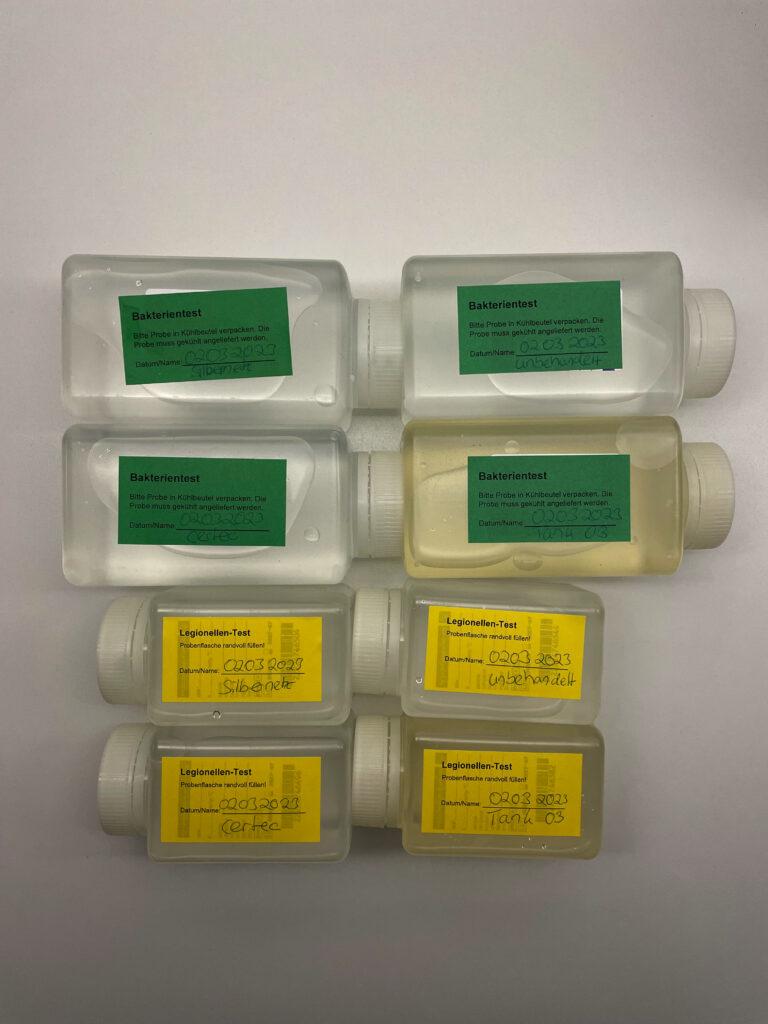
Large water test
We have always been plagued by the question of how best to conserve the water in our Cali so that it will last as long
This diesel test was similar. 😅
I had a discussion with someone on Facebook. It was about whether you should park a car, motorhome, Grand California or whatever over the winter with a full or empty tank.
The discussion went back and forth, and I was of the opinion that a full tank was better, as no diesel pest could form.
In any case, we couldn’t agree, so it was clear that we had to test it.
No sooner said than done 🙂
So we came up with an experimental setup and then had the samples from the test analyzed in the laboratory.
Structure / Procedure

For the test, we used four laboratory bottles of the same size, each with a capacity of one liter.
We filled each of these bottles differently:
- Full of diesel fuel
- Full with diesel fuel and additional diesel additive
- Only fill the bottom of the bottle with diesel fuel
- Only fill the bottom of the bottle with diesel fuel and additive
Why four bottles and why different fillings?
Quite simply: the bottles simulate the tank. As mentioned at the beginning, either a Cali with a full tank or an almost empty Cali.
The samples with the diesel additive should clarify whether an additive has an influence on the quality of the fuel.
We filled the samples evenly in the summer and simply stored them in our hall until October 10th. This was to simulate the standing time over the “winter”. After around 3.5 months, we took the samples and sent them to a laboratory for analysis.
The result
The result of the analysis surprised us – and somehow not. 😅
- None of the samples met the requirements for viscosity, which is essential for lubrication in the engine.
- The additive had no influence whatsoever, neither positive nor negative.
- The full bottles had a lower water content in the fuel.
So what can we deduce from the results? Above all, that diesel with a long service life significantly loses quality. If you consider that the samples were only stored for 3.5 months and that this short time is already enough for the fuel to no longer meet the standard, you don’t even want to imagine what it looks like after 6 months.
Then there is the water content in the fuel. Everyone knows that water and engines do not mix well. It increases wear and can damage the engine in the long term.
Conclusion
Now you’re probably wondering: should I fill up the Cali before the winter break or is it better not to?
As the fuel quality decreases significantly over the hibernation period, it makes little sense to leave the tank completely full over the winter. Although the water content is lower with a full tank, if you fill the vehicle with fresh diesel directly at the filling station after hibernation, the water content is hardly noticeable and the fuel quality automatically improves.
Video of the test setup
Would you like to support us and see the exact lab results? No problem! You can purchase them from our store and support us with them.

